

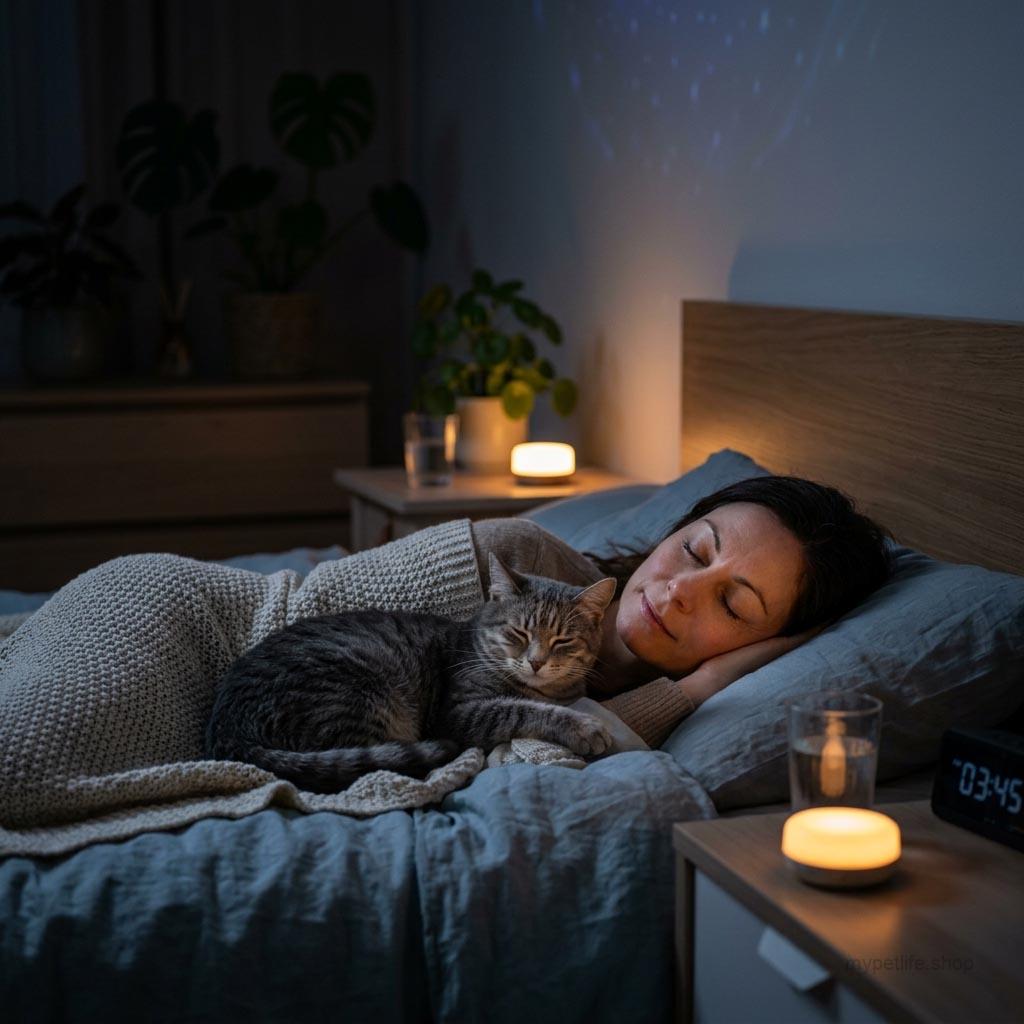
It’s 2 AM. The house is dark, the world is quiet, and I feel a familiar pressure on my chest. Soft paws, gentle kneading, and then—the purr. A low, rumbling, almost motor-like hum that vibrates through my ribcage and settles somewhere deep in my heart.
My cat Luna has chosen her spot. Again. And honestly? I wouldn’t trade it for the most expensive weighted blanket money can buy.
If you’ve ever woken up with a cat sleeping on your chest, you know exactly what I mean. It’s inconvenient. It’s slightly uncomfortable. Your arm falls asleep. You desperately need to turn over but you don’t dare disturb the tiny furry monarch who has claimed you as their throne.
And yet, there’s something about that midnight purr that feels like pure magic. It’s not just warmth or habit. It’s a wordless conversation between two species who somehow learned to trust each other.
The Science Behind the Purr (It’s Not Just Vibration)
For years, scientists believed that cats purred simply as a sign of contentment. And that’s partly true. But recent research has uncovered something much deeper.
A 2026 study published in the Journal of Feline Medicine and Surgery found that domestic cats purr at frequencies between 25 and 150 Hertz—the same range known to promote bone density, reduce pain, and speed healing in mammals (Journal of Feline Medicine and Surgery, 2026). Some researchers have even suggested that the purr may have evolved as a low-energy way for cats to keep their bones and tissues healthy during long periods of rest.
But here’s the beautiful part: when your cat purrs on your chest, you’re not just hearing it. You’re feeling it. The vibration travels through your body, and studies have shown that these low-frequency vibrations can lower stress, reduce blood pressure, and even ease anxiety in humans(Harvard Health Publishing, 2026). Your cat isn’t just comforting themselves. They’re literally healing you with their purr.
A 2025 study from the University of Vienna found that when a cat sleeps on a human’s chest, both the cat and the human experience synchronized heart rate variability, indicating a shared state of calm and emotional attunement(University of Vienna, 2025). In other words, you’re not just sharing a bed. You’re sharing a nervous system.
Why the Chest? Why Not the Feet or the Sofa?
If you’ve ever wondered why cats specifically choose your chest, there’s a reason. Your chest is warm. Your heartbeat is audible and reassuring. And your face is close enough that your cat can watch you breathe, listen to your breathing patterns, and feel instantly alerted if something changes.
For a small predator who sleeps lightly (despite appearances), your chest is the safest real estate in the house. It’s warm, it’s elevated, and it’s attached to the giant human who provides food, treats, and chin scratches.
But there’s something deeper too. Cats are social animals, despite their reputation for aloofness. Sleeping on your chest is a sign of profound trust. In the wild, a cat would never sleep belly-up on top of another animal unless they felt completely safe. When Luna sprawls across my chest, paws in the air, purring like a tiny tractor, she’s telling me: “I trust you with my life. Also, don’t move.”
A 2025 survey by the American Association of Feline Practitioners found that over 60% of cat owners reported their cat sleeping on their chest or torso at least once a week, and 85% of those owners said it made them feel “deeply connected” to their pet(AAFP, 2025). You’re not alone in your midnight adventures.
The Unspoken Bond
Sometimes, in those quiet, dark hours, I find myself whispering to Luna. Nothing important. Just small things. “You’re a weird little creature, you know that?” Or “Thanks for not biting my nose tonight.” She doesn’t respond, of course. She just purrs louder, as if to say, “I know. Now go back to sleep.”
There’s something profoundly humbling about being chosen as a cat’s sleeping spot. We humans like to think we’re the ones in charge. We buy the food, we clean the litter box, we open the cans. But at 2 AM, with a warm, purring cat on your chest and your arm completely numb, you realize the truth: you don’t own a cat. You’ve been adopted by one. And the rent is paid in belly rubs and obedience to their sleeping schedule.
I used to think that love had to be loud, dramatic, and full of grand gestures. But Luna taught me otherwise. Sometimes love is quiet. Sometimes love is a warm weight on your chest at midnight, a vibration that says “I’m here. You’re safe. We’re okay.”
And honestly? That’s more than enough.
Final Thoughts: The Gift of the Midnight Purr
So no, I don’t always sleep perfectly. Yes, my back sometimes hurts from staying still too long. And yes, I’ve definitely drooled on Luna’s fur more times than I’d like to admit.
But every time I feel those soft paws kneading my chest and that familiar rumble begins, I smile in the dark. This is what trust sounds like. This is what love feels like. This is the midnight purr.
If you have a cat who sleeps on your chest, consider yourself lucky. You’ve been chosen. And if you don’t, maybe tonight, when your cat curls up somewhere unexpected, you’ll look a little closer. They might be trying to tell you something.
🐾 Does your cat sleep on your chest? Or do they have another quirky sleeping spot? Share your story in the comments below. I’d love to hear about your midnight adventures.
And if you’re looking for the perfect cozy bed to give your cat their own special spot (when they’re not using you as one), visit our MyPetLife Shop. We have beds that are almost as warm as a human chest. Almost.
Related Posts
The midnight purr: why my cat sleeps on my chest every night
What my pet will never know (but I hope they feel)
My dog doesn’t fetch, and that’s okay